Engineering
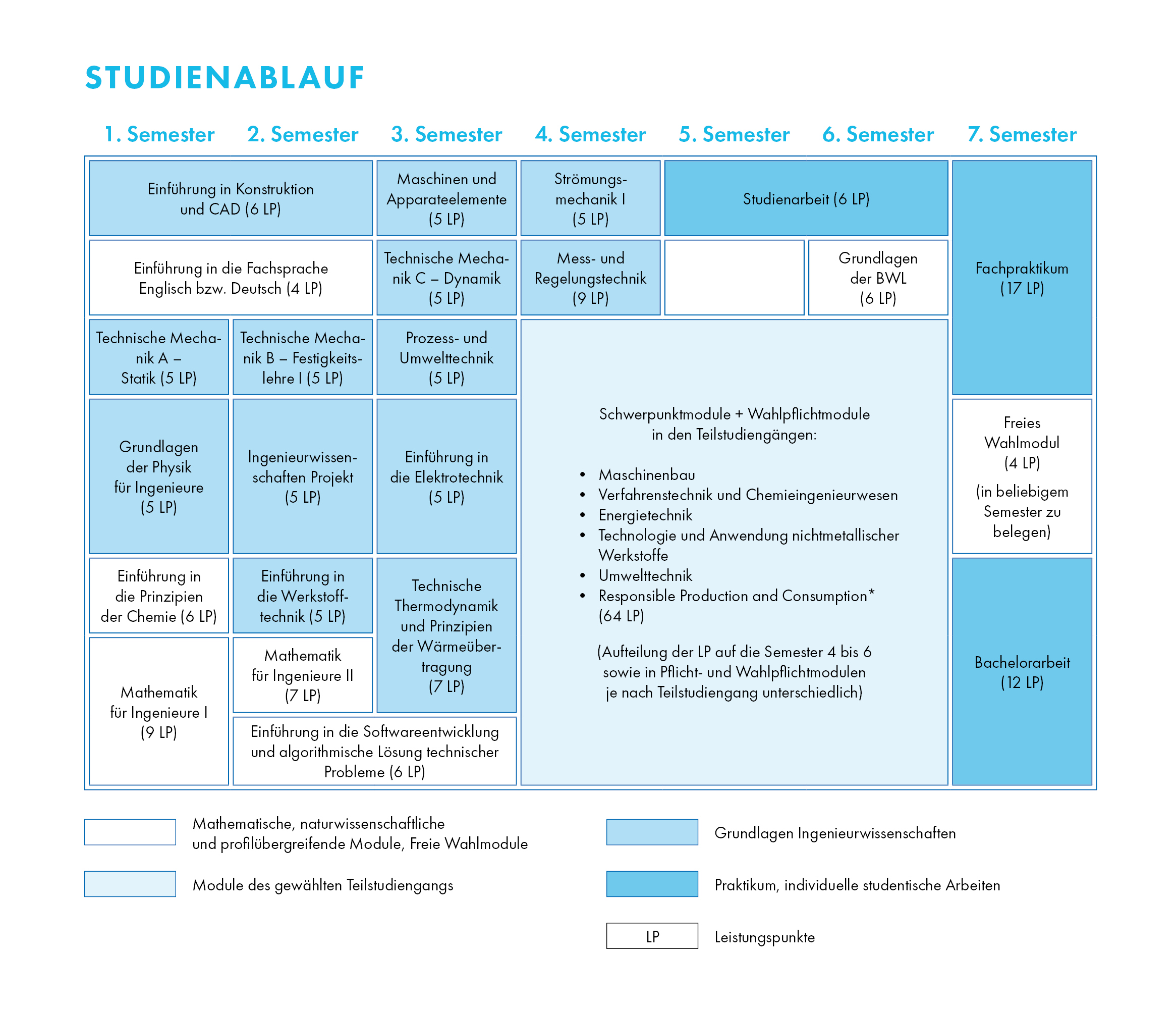
The engineering degree programme teaches all relevant fundamentals of the engineering disciplines. Students do not decide on a specialisation right from the start, but only after three semesters for a partial course of study.
Engineering at TUBAF is characterised by flexible content but strict, fundamental course content as a future-oriented course of study and is perfect for preparation for future requirement profiles, in further engineering activities, in industry, business or science.
The Bachelor's degree programme includes practical and research experience in the basic internship, specialist excursions, a student research project, a 14-week specialist internship and a Bachelor's thesis. The programme also provides training in English and introductory business administration, which could be the first step towards an international orientation.
The first three semesters differ only slightly from the first three semesters of all engineering degree programmes at the faculty (Diplom Maschinenbau, Diplom Verfahrenstechnik & Chemieingenieurwesen). The courses take place together. Students get to know and understand the diversity of engineering disciplines and their scientific and engineering fundamentals. For example, fluid mechanics, materials engineering, electrical engineering, introduction to design and CAD and much more.
The sub-degree programme is selected from the following options:
- Mechanical Engineering
- Process Engineering & Chemical Engineering
- Energy Engineering
- Environmental technology
- Technology and application of non-metallic materials
- Responsible Production and Consumption
After choosing the sub-degree programme, students acquire explicit specialised knowledge and skills. These will qualify students for a possible Master's degree programme or the desired career path. The degree obtained in this degree programme is called Bachelor of Science (B.Sc.) not in the Engineering degree programme, but in the chosen sub-degree programme. For example B.Sc. Mechanical Engineering or B.Sc. Environmental Engineering.
Partial study programmes
Mechanical engineering
The mechanical engineering deals with issues relating to the development, production and operation of machines, systems and vehicles. In particular, it deals with design and calculation as well as the underlying mechanics, electrical drive technology and automation. In addition, there are industry-specific offerings such as electromobility, machines for raw materials processing and extraction as well as cross-industry offerings such as simulation and additive manufacturing.
Thanks to its broad applicability, mechanical engineering makes it possible to deal with current and future challenges from all areas of the economy.
Process Engineering & Chemical Engineering
Process Engineering and Chemical Engineering is the engineering science of mechanical, thermal, chemical and biological material conversion with a particular focus on economics and sustainability.
For example, plastic waste or agricultural residues to fuels or commodity chemicals; commodity chemicals to recyclable materials; renewable raw materials to energy; milk to yoghurt; hops, malt and water to beer or even soil, water and air pollution control.
The interdisciplinary specialisation provides training in all areas of process engineering and chemical engineering and results in a balanced relationship between fundamentals and their applications.
Energy technology
Energy Technology deals with the technologies that are necessary to provide, distribute and utilise electrical energy, heat or another form of energy in an environmentally friendly, efficient, safe, economical and future-oriented manner.
In addition to advanced lectures on thermodynamics and fluid mechanics, decentralised and renewable energy generation, energy storage and efficient combustion technology are also covered. Supplementary courses on simulation methods and energy economics prepare graduates for solving future problems in the energy sector.
.
Environmental technology
The Environmental Engineering ensures environmental compatibility, social acceptance and international competitiveness in the design, construction and operation of technical facilities. The focus is on projects for the protection of the environment, the sustainable use of resources, the recycling of residual materials and the closing of material cycles.
The practical specialisation for this takes place in various areas of process engineering, chemistry and biology. It is geared towards the acquisition of teamworking skills and preparation for lifelong learning in order to maintain a balance between technology and the environment for future generations.
Technology and application of non-metallic materials
The Technology and Application of Non-Metallic Materials focusses on the future materials of industry. From glass fibres and heat-insulating building materials to ceramic heat shields for space technology.
In the process engineering specialisation, classic areas of application such as porcelain, container glass or bricks and high-tech developments such as smart glass, diesel soot filters and fibre concretes come together. During production from the raw material to the finished product, there are numerous tasks that need to be solved using interdisciplinary expertise.
Knowledge of raw materials and their properties, energy-efficient processes and systems of the various technologies, the wide range of materials, testing and analysis methods are taught as well as aspects of environmental protection, marketing and quality assurance.
Responsible Production and Consumption
Students on the "Responsible Production and Consumption" sub-degree programme become European experts in sustainability. They acquire a critical awareness of the responsible use of resources and goods. Based on engineering fundamentals, they develop the ability to recognise technical, economic, social and legal aspects of sustainable production.
According to the sub-degree programmes in corresponding branches of industry, educational institutions, research institutions and authorities:
Professional activities
Energy supply companies
Engineering, public service, management
Production control or monitoring
- Faculty
-
Faculty of Mechanical, Process and Energy Engineering (Faculty 4)
- Degree
-
Bachelor of Science (B. Sc.)
- Standard period of study
-
7 Semester
- Part-time possible
-
No
- Start of studies
-
Winter semesterSummer semester
- Admission requirement
-
Abitur or subject-restricted higher education entrance qualification or an entrance qualification recognised as equivalent
Basic internship
A 6-week basic internship is required for this degree programme (30 working days).Language skills
Application: with at least B1 level German
Admission to the degree programme: with C1 level German (e.g. DSH-2)
Language courses and DSH examination
.e.g. DSH-2)
Language courses and DSH exam at TUBAF
Studienkolleg for international applicants - Course language
-
German
Downloads
Interest and skills for the degree programme
Basic understanding of maths and science subjects (no advanced level required) as well as an interest in engineering, enthusiasm for new things, perseverance and some self-discipline and ambition.
Information on the basic internship
A 6-week basic internship is required for this degree programme (30 working days). Completion or partial completion of the internship before the degree programme (after graduating from high school) is recommended. The internship can also be completed during the degree programme. Requirements for the basic internship can be found in the adjacent download. Dr Andrea Dög will be happy to answer any questions you may have (see the box on the right "Specialist advice").
Rankings

Indicator | Mean value for TUBAF | Mean value for all universities |
| General study situation | 4,4 | 3.8 |
| Study organisation | 4.8 | 4.4 |
| Study support | 4,4 | 3.8 |
| Laboratory practicals | 4.7 | 4.0 |
| Scientific competences | 4.5 | 4,2 |
| Methodological competences | 4.5 | 4.1 |
| Interdisciplinary competences | 4.1 | 3.7 |
Reasons for studying engineering at TUBAF


Innovative forms of teaching
In addition to the necessary skills to meet current and future needs of the labour market, the Bachelor's degree programme in Engineering also imparts innovative designs of the course content. The specialisation in the form of a partial degree programme must be chosen after the third semester.
Students at the centre
Students' needs are given strong consideration at TUBAF. Small groups, close contact with professors and their teams and individual support also characterise studying in Freiberg. Future-oriented skills and creative personalities are fostered through direct exchange. There is a manageable number of examinations, the strict study programme is supported, numerous elective options as well as application and research relevance at an early stage of the degree course. Accommodation is affordable and sufficiently available.
Research-intensive university
For the size of a university, TUBAF is very small, but very research-intensive. Researchers need support from students and research assistants. As a paid research assistant, students can combine their studies, research and part-time job and gain insights into current research. Graduates are also the doctoral students of tomorrow, with whom we enjoy working together on the challenges of the future.
International in Freiberg
Lecturers maintain and benefit from international contacts in the context of research. Students are supported in organising a semester abroad or a Bachelor's thesis at an international research institution. TUBAF also has excellent contacts with sponsors who support students in the form of scholarships. The chance of obtaining a scholarship is quite high. Tandem partners are also regularly sought.
From Bachelor to Master
The following Master's degree programmes offer a logical continuation of the Bachelor's degree:
Introduction to the degree programme
Fascination with technology - study engineering in Freiberg