Smart Systems Engineering
Technical systems are becoming increasingly complex, networked and dynamic - from automated production systems and autonomous mobile robotics to intelligent energy and assistance systems. In order to develop such systems, engineers are needed who can confidently combine mechanics, electronics, computer science and systems thinking and take a holistic view of technology.
The Bachelor's degree programme offers you a modern, application-oriented engineering education. You will learn not only to develop networked and dynamic systems, but also to understand their interaction and design them in a targeted manner.
A technical system depends on the interaction of its components: Mechanical structures form the physical basis, electronics enable perception and control, digital control logic ensures intelligent decisions. It is only through systemic integration and sound methods that an efficient overall system is created.
This is precisely where the degree programme comes in. In addition to the classic engineering fundamentals, the focus is on the principles of systems engineering - from modelling, control and analysis through to the integration of complex technical systems.
A central aim of the course is also to design technical systems responsibly: in a way that conserves resources, is energy-efficient and takes social requirements into account. This will prepare you specifically for the challenges of modern and sustainable technology development.
Fields
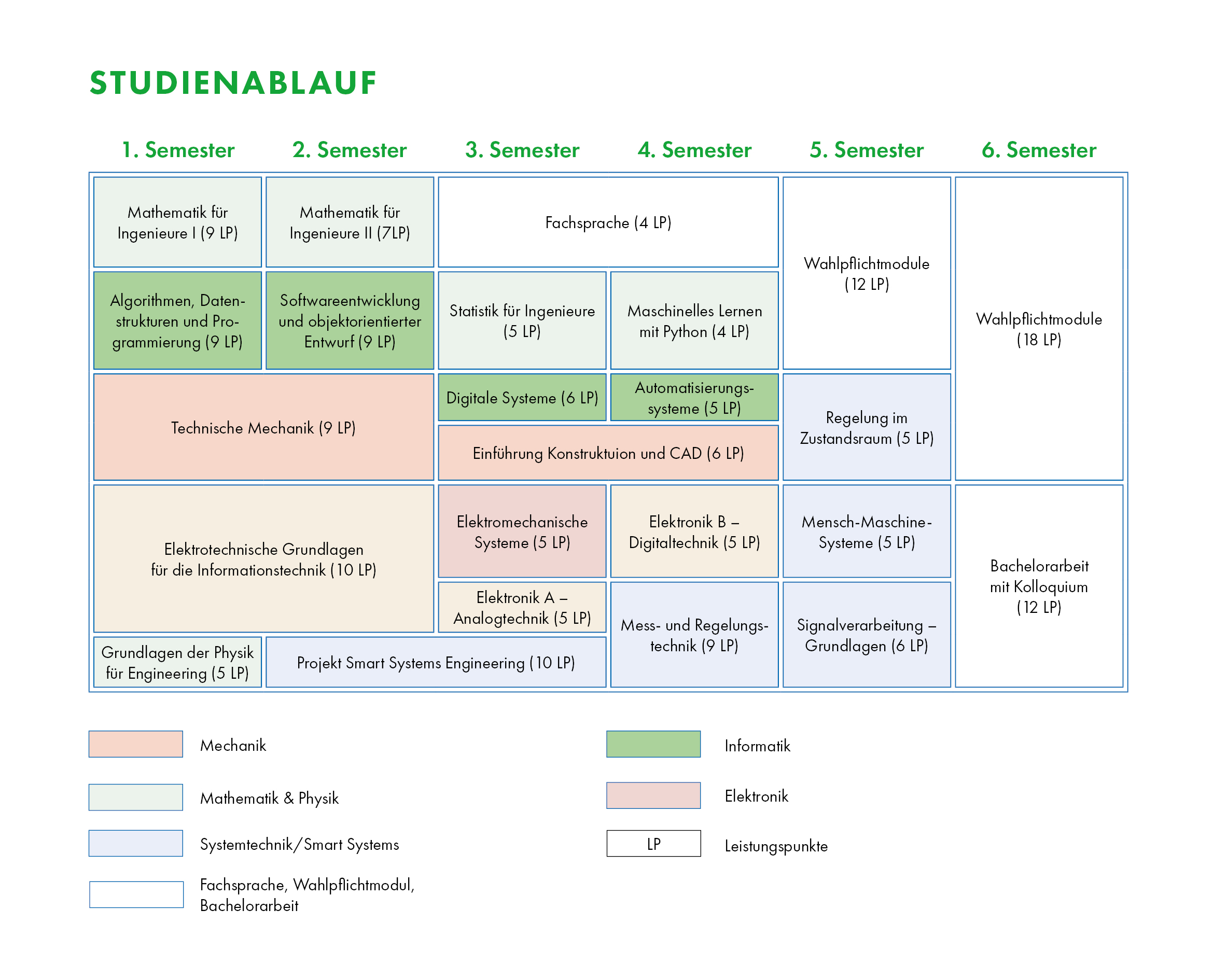
Mechanics - enabling action
What you will learn:
In mechanics, you will deal with the physical principles of technical systems. You will learn how forces, movements and structures work and how mechanical components are designed and evaluated.
Relation to systematics:
Mechanics forms the basis for the operation of technical systems - from robot arms to mobile platforms. It ensures that decisions can also be reliably implemented.
Electronics - Perception and control
What you will learn:
You will learn how sensors record physical variables, how electronic circuits process signals and how actuators are specifically controlled. The focus is on both analogue and digital systems.
Relation to systematics:
Electronics enables the perception of the environment and the technical control of systems - it is the interface between the physical world and digital processing.
Computer science - understanding and deciding
What you will learn:
In computer science, you will learn to control technical systems using software, analyse data and develop algorithms. This includes programming, data processing and the basics of intelligent systems.
Relation to systematics:
This is where understanding and decision-making take place: Measurement data becomes information, information becomes decisions that determine the behaviour of the system.
Systems engineering - Integrate and think holistically
What you will learn:
Systems engineering combines all sub-disciplines. You will learn to model, analyse, control and integrate complex technical systems as a whole.
Relation to systems engineering:
Systems engineering stands for the integration and operation of smart systems - it ensures that mechanics, electronics and software work together reliably.
Maths & Physics - Understanding the basics
What you will learn:
Mathematics and physics provide the theoretical basis for understanding technical systems. You will learn to describe interrelationships, develop models and analyse systems.
Relation to systematics:
They form the basis for understanding technical processes and enable well-founded decisions in all other areas of the degree programme.
- Faculty
-
Faculty of Mathematics and Computer Science (Faculty 1)Faculty of Mechanical, Process and Energy Engineering (Faculty 4)
- Degree
-
Bachelor of Science (B. Sc.)
- Standard period of study
-
6 Semester
- Part-time possible
-
Yes
- Start of studies
-
Winter semester
- Admission requirement
-
Baccalaureate or subject-restricted higher education entrance qualification or an entrance qualification recognised as equivalent
Language skills
- Application: With at least B1 level German
- Starting the degree programme: with C1 level German (e.g.B. DSH-2)
- Language courses and DSH exam at TUBAF
- Studienkolleg for international applicants
- Course language
-
German
Interests and skills you should bring with you
You are interested in how technical systems work - not just individual components, but the interplay of mechanics, electronics and software. You enjoy understanding, analysing and implementing things in practice. If you like to think logically, structure technical issues and are keen to deal with more abstract concepts, you have what it takes for the degree programme. Programming experience or extensive previous knowledge is not required - what is important is curiosity, motivation and a willingness to learn new things. An interest in maths and science, enjoyment of experimentation and a willingness to work on complex tasks as part of a team are also helpful. During your studies, you will learn to take responsibility for technical decisions and reflect on their impact on people, the environment and society.
Why study Smart Systems Engineering at TUBAF?
The Technische Universität Bergakademie Freiberg combines a long engineering tradition with current issues in modern technology development. With the Smart Systems Engineering degree programme, you will study at a place where complex technical systems are not only considered theoretically, but also researched and developed in a practical way. The particular strength of TUBAF lies in its interdisciplinary orientation. Mechanical engineering, electrical engineering, computer science and systems engineering work closely together here - just as the development of smart systems requires. You benefit from short distances, personal support and a study environment in which research, teaching and application are closely interlinked. Project-orientated modules, modern laboratories and the integration of current research and industry issues will give you an early insight into real-life applications. At the same time, TUBAF offers an ideal environment for analysing technical systems in the context of sustainability, resource efficiency and social responsibility. Smart Systems Engineering at TUBAF means thinking holistically about technology, implementing it in practice and developing it responsibly - in a personalised study environment with a strong focus on research.
Occupational fields and careers
Smart Systems Engineering opens up a wide range of career paths in industry, development and research. You will work on intelligent, networked technical systems - for example in robotics, automation, digitalisation or sustainable technology development. The degree programme prepares you for direct career entry as well as for a further Master's degree course.
Examples of industries and typical tasks
- Automation and Production Engineering
Development and integration of intelligent production systems, robotics, digital and networked manufacturing systems
e.g. as a development engineer in the field of automation and production engineering - Robotics and autonomous systems
Development of mechatronic and autonomous systems, collaborative robotics, assistance systems
e.g. as a robotics engineer or embedded systems engineer - Machine and plant engineering
Design and further development of intelligent machines, mechatronic assemblies and networked systems
e.g. as a development engineer or system integrator - Electrical engineering, electronics and embedded systems
Development of sensor, actuator and control systems for intelligent applications
e.g. as an embedded systems engineer or automation engineer - Energy, environmental and sustainability engineering
Smart energy systems, environmental monitoring, resource-efficient and sustainable technical solutions
e.g. as an engineer for intelligent energy systems or technical system analysis - Process, chemical and process engineering
Automation, monitoring and optimisation of complex technical processes using intelligent systems
e.g. as a project engineer or systems engineer - Research and development
Working in development departments, research institutes or technology-oriented start-ups
e.g. as a development engineer or as part of an advanced master's programme
The most exciting innovations arise from the interplay of mechanics, electronics, and computer science. Smart Systems Engineering combines precisely the skills that I use today in the development of autonomous systems. For me, this is the ideal engineering education.
Norman Seyffer
The degree programme is supplemented by a consecutive Master's degree programme at TUBAF, so that further studies are possible at the same location.