In the field of crash, our focus is on researching the deformation behaviour of components and materials under crash-like loads.
Dipl.-Ing. (FH) Dr.techn. Robert Szlosarek
Karl-Kegel-Bau, Room 63
+49 (0)3731 39-3653
Robert [dot] Szlosarek [at] imkf [dot] tu-freiberg [dot] de
Focal points
Crash absorber
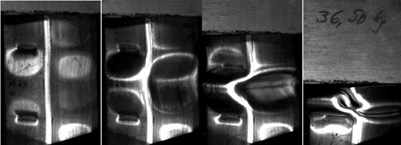
In frontal, rear and oblique impacts of vehicles, the functioning of crash absorbers is of crucial importance for occupant safety. As part of drop tower tests, the IMKF is investigating new types of crash absorbers (with active elements, different trigger types, progressive behaviour) and new materials (fibre-plastic composites, magnesium, 3D printed components). The evaluation of the deformation behaviour and the force-displacement characteristics provides conclusions for the suitability of the component in the overall vehicle.
Literature:
Szlosarek R., Luft J., Wittig F., Ullmann M., Prahl U., Kawalla R., Kröger M. Improving the crashworthiness of magnesium AZ31 by tapering and triggering, (2021) Thin-Walled Structures, 162, art. no. 107565, https://doi.org/10.1016/j.tws.2021.107565
Zarei H., Kröger M., Albertsen H. An experimental and numerical crashworthiness investigation of thermoplastic composite crash boxes (2008) Composite Structures, 85 (3), pp. 245 - 257, DOI: https://doi.org/10.1016/j.compstruct.2007.10.028
Zarei H.R., Kröger M. Bending behaviour of empty and foam-filled beams: Structural optimization(2008) International Journal of Impact Engineering, 35 (6), pp. 521 - 529, DOI: https://doi.org/10.1016/j.ijimpeng.2007.05.003
Zarei H.R., Kröger M. Crashworthiness optimisation of empty and filled aluminium crash boxes (2007) International Journal of Crashworthiness, 12 (3), pp. 255 - 264, DOI: https://doi.org/10.1080/13588260701441159
Screws and screw connections
Screws are one of the most popular fasteners in mechanical and plant engineering. In addition to quasi-static and cyclic loads, bolts are also subject to impact loads (e.g. from explosions or crash situations). The failure behaviour of bolts and bolted connections under high stress rates is investigated in drop-weight tests with the aim of achieving a targeted dimensioning of bolted connections for these types of stress.
Roth T., Szlosarek R., Kröger M. Mechanical behaviour of high-strength bolts under different stress rates,Materials Testing 2025, 67(8), pp. 1326-1334 https://doi.org/10.1515/mt-2025-0101
Szlosarek R., Roth T., Kröger M. Investigation of impact strength for bolts loaded by drop tower tests (2025) VDI Berichte 2466, pp. 323 - 338, https://doi.org/10.51202/9783181024669-323
Gallery
Expertise
Drop weight
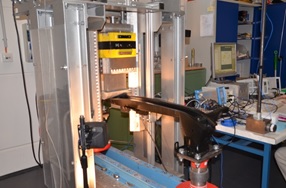
Crash structures can be tested in the drop centre at speeds of up to 45 km/h and a mass of 300 kg (corresponds to an impact energy of approx. 28 kJ at a drop height of 9.5 m). The evaluation of the force-displacement curve and the high-speed video make it possible to assess the component and material behaviour. In addition to central, axial compression loads, test setups for oblique impact and bending loads (three- and four-point bending) are also available.
Crash roller carriage
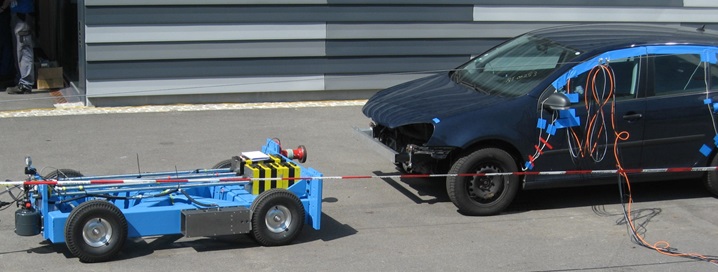
A cable-drawn crash trolley can be used to simulate various crash situations with complete vehicles. The crash trolley can be variably configured with a mass of between 850 kg and 1500 kg. It is also possible to apply different impactors or a front end structure with integrated force measurement. The entire test setup is mobile so that the tests can be carried out at any suitable location.