Testing and simulation systems
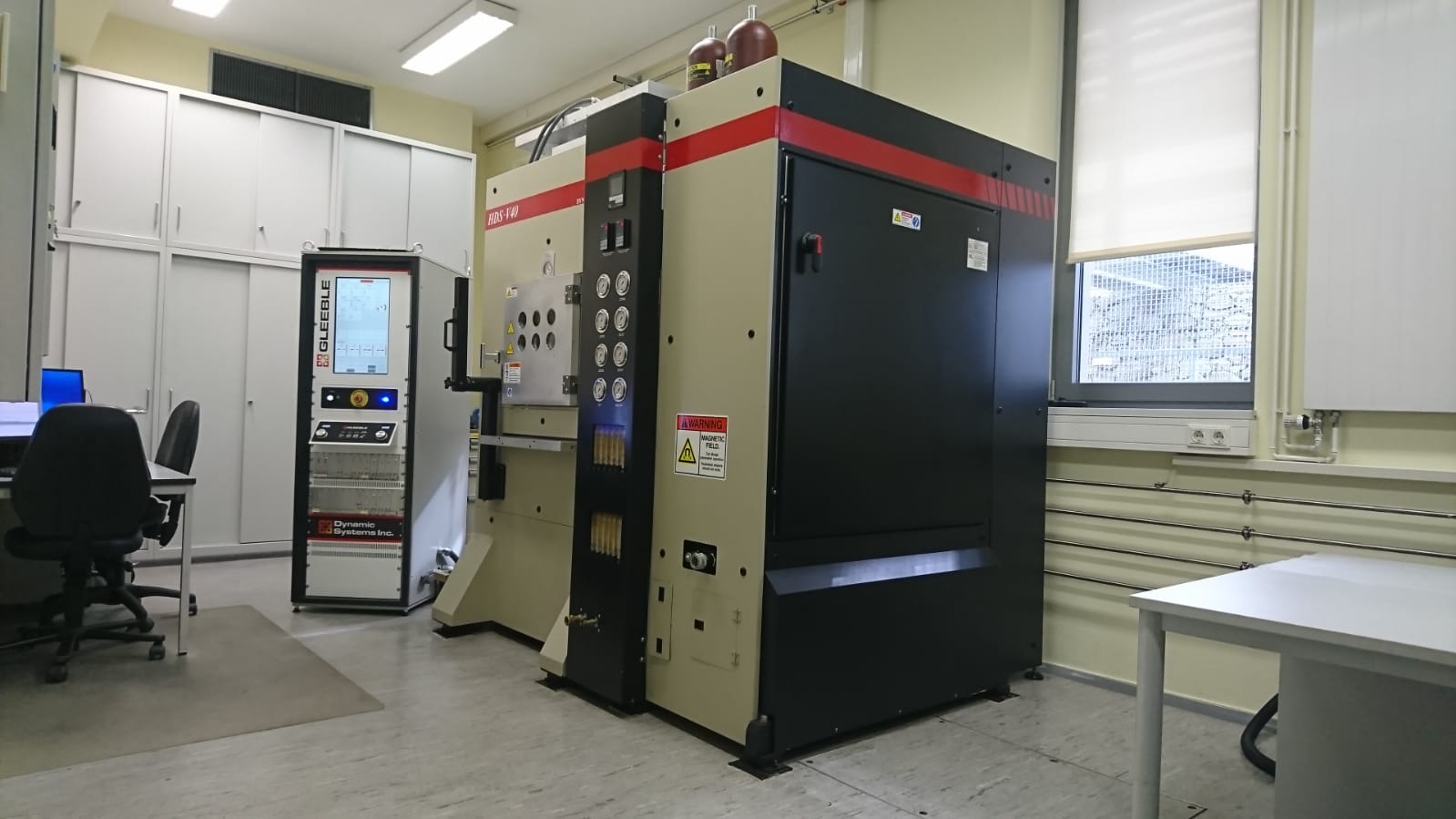
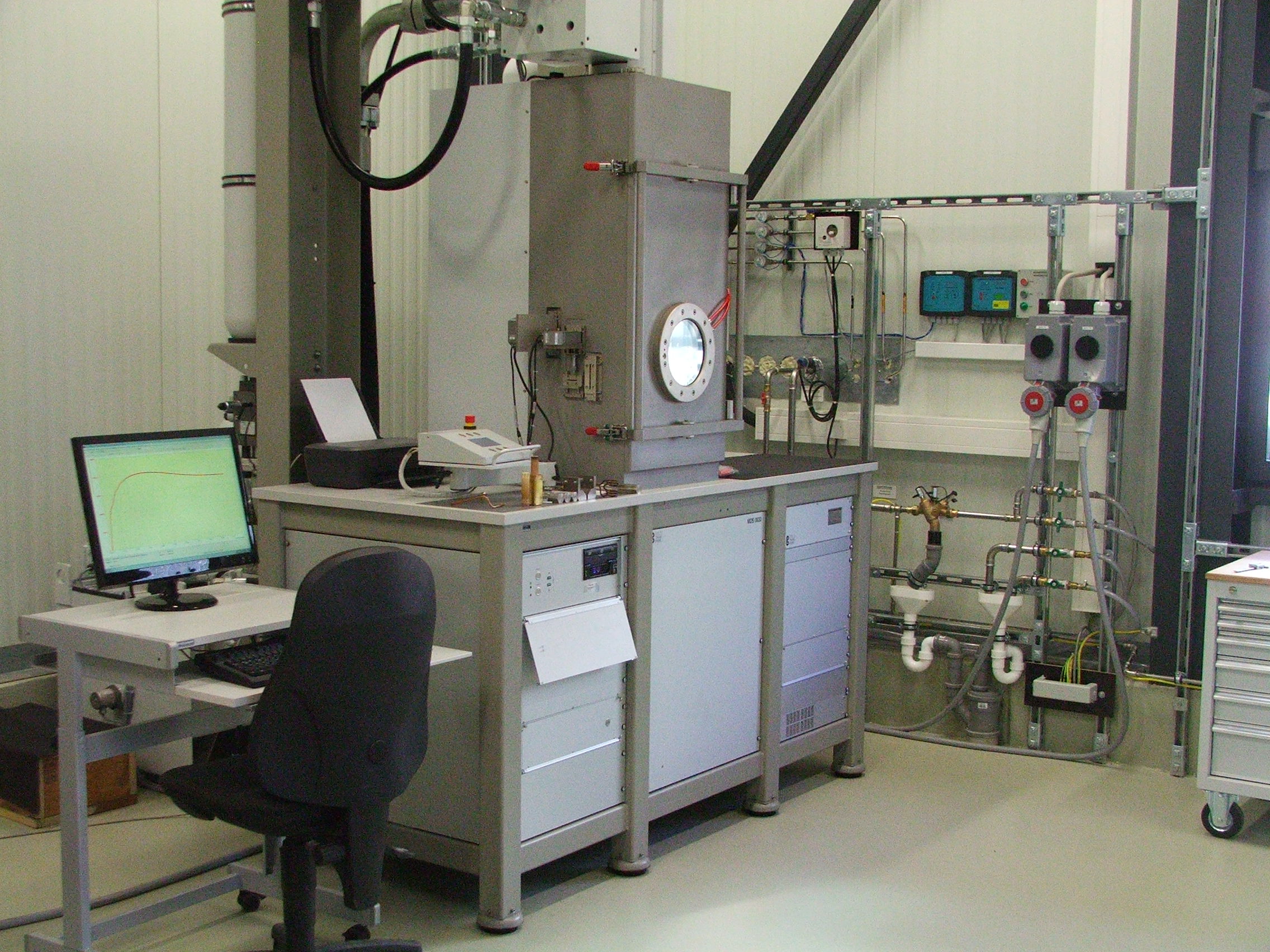
Gleeble HDS-V40
With the Gleeble HDS-V40, the Institute of Metal Forming has a powerful system for simulating technological process chains on a small laboratory scale and for determining the forming parameters and properties of metallic materials. In addition to the cylindrical upsetting test and the flat upsetting test for simulating strip and sheet rolling processes, tensile tests can also be carried out using an external MCU unit. For the simulation of wire and rod rolling processes, a MaxStrain installation can also be realised, in which the specimen is always tilted by 90° between individual forming stages, so that the classic H-V arrangement of modern wire rolling mills can be simulated.
Sample heating takes place conductively in the system with the option of specifying heating speeds and holding times. In combination with the possibility of specifying several forming steps, entire process chains, for example stitch plans during hot rolling, can be simulated in the system.
As a special feature, the system is able to melt samples in the flat crush test and tensile test, so that a melting and solidification simulation with subsequent forming processes can be simulated and the influence of different initial and solution states on the forming and softening behaviour can be investigated.
For temperature monitoring, up to four thermocouples can be attached to the samples and controlled preheating of the upsetting tools is also possible if required.
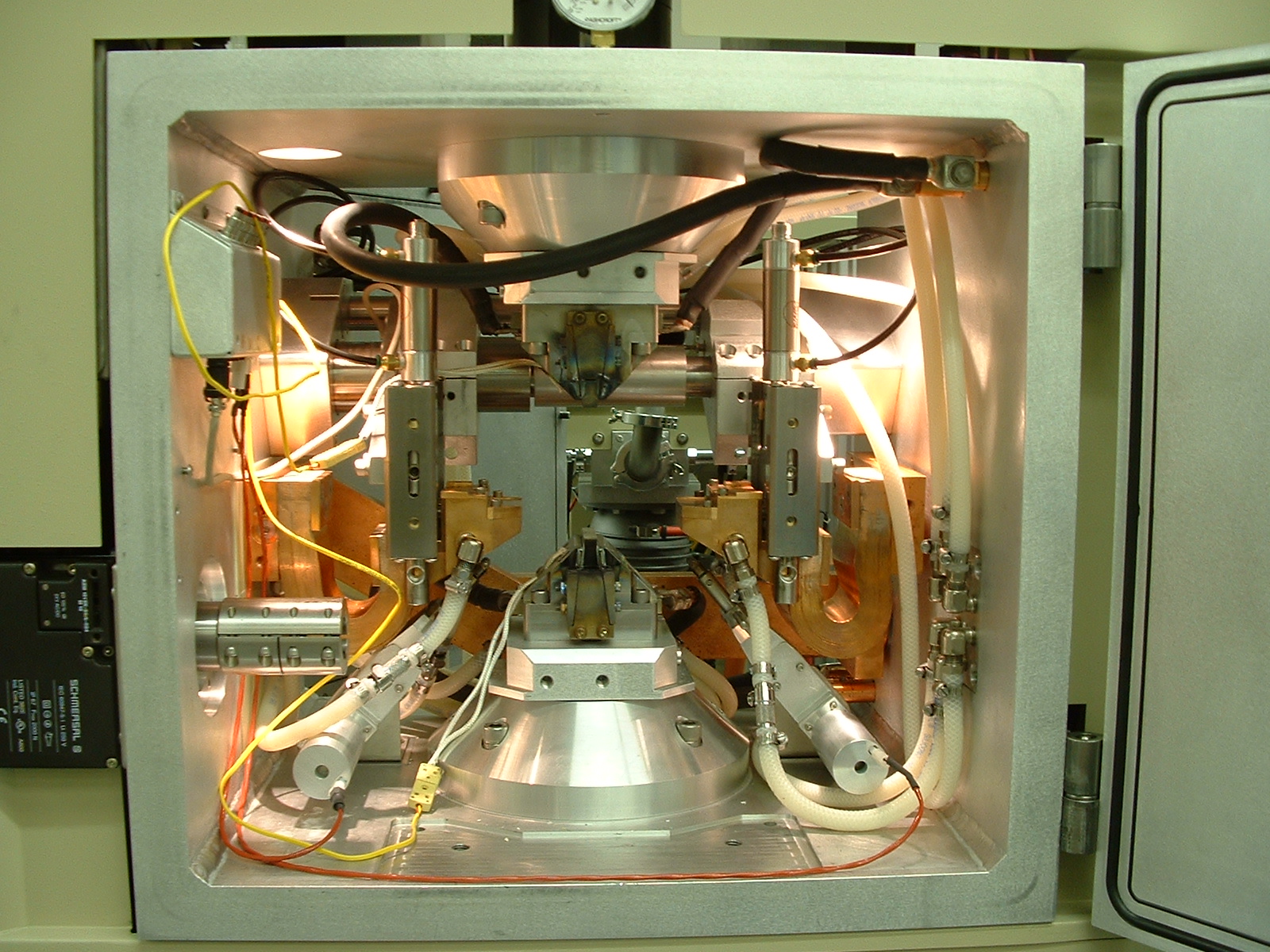
BÄHR MDS-830 multidirectional testing system
The MDS-830 multidirectional testing system from BÄHR-Thermoanalyse GmbH opens up new possibilities for testing and describing materials for the Institute of Metal Forming.
The system is designed as a multi-axis forming system and opens up the possibility of precisely investigating the influence of forming on the phase transformation and thus allows not only the creation of classic ZTU diagrams but also the generation of U-ZTU diagrams to reproduce the influence of forming processes on the transformation kinetics.
For this purpose, the samples are inductively heated in the system with a specified heating curve and, if necessary, held at a desired temperature in order to be subsequently formed in a defined manner. It is possible to test compression specimens in the cylinder crush test or round specimens or flat specimens in the tensile test.
In addition, the specimens can be subjected to a torsional load or the load combination of tension/torsion or compression/torsion for the investigation of more complex deformation and stress states can be realised, whereby different forming stages can be programmed.
The subsequent phase transformation during cooling can be reproduced using the integrated dilatometry equipment, whereby the cooling rate can also be specified as a function of time.
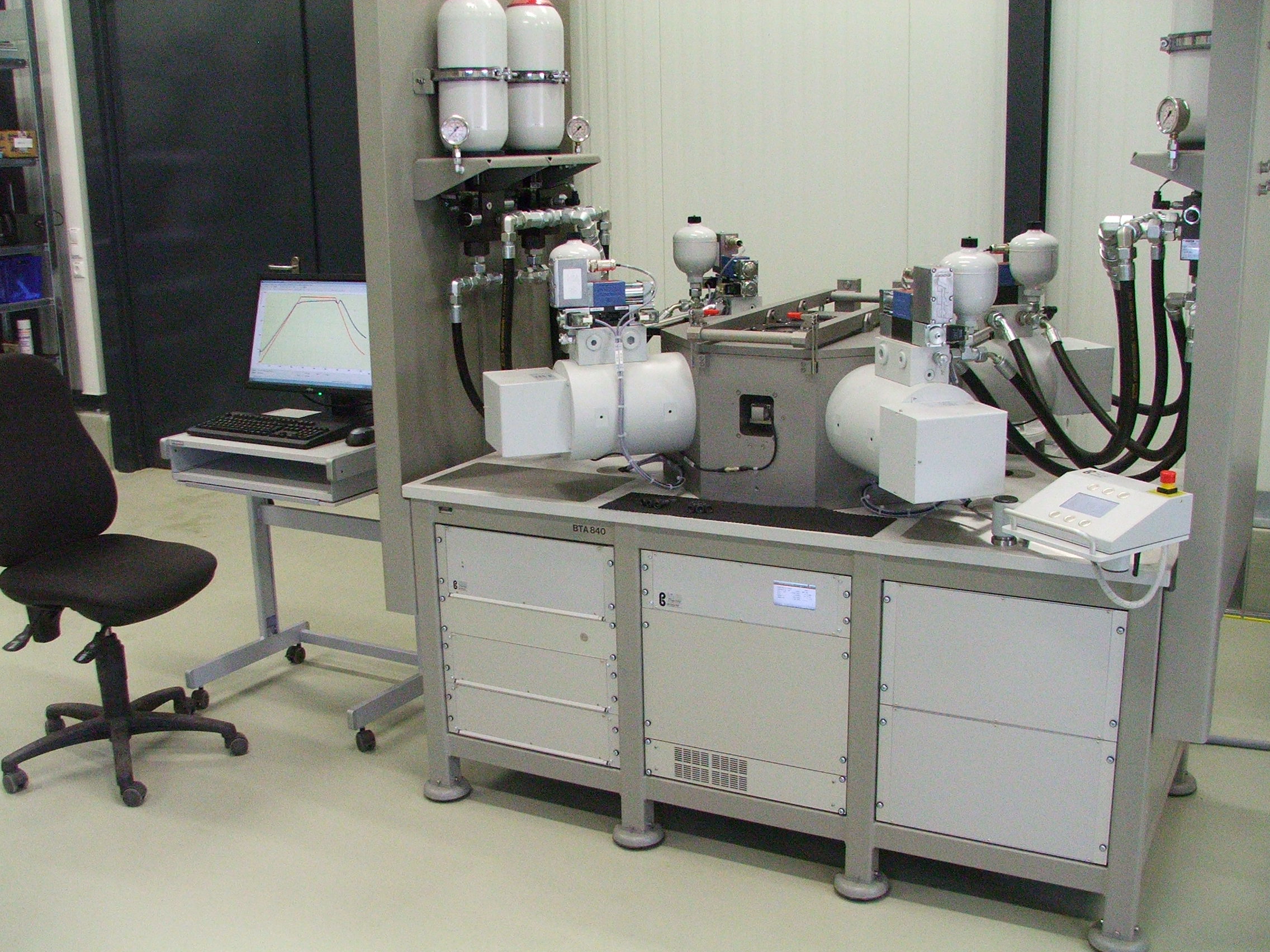
BÄHR BTA-840 biaxial testing device
With the BÄHR BTA-840 biaxial testing system, the Institute of Metal Forming has another prototype system for determining material characteristics under complex stress and deformation conditions from BÄHR Thermoanalyse GmbH.
The system makes it possible to apply uniaxial or biaxial stress and deformation conditions to specimens. For this purpose, the system is equipped with four hydraulic cylinders that are aligned crosswise at right angles in one plane and can each be controlled individually in order to transfer tensile or compressive stress to the sample, which enables the system to simulate deep-drawing and stretch-drawing processes, among other things.
Induction coils are installed above and below the specimen in the area of the intersection point to heat the centre of the specimen, allowing the very precise specification of temperature-time curves.
In addition to the options for measuring the specimen temperature and the force-displacement curves of the individual hydraulic cylinders, the system is also equipped with a forming dilatometer, which makes it possible to determine ZTU and U-ZTU diagrams under complex stress conditions.
Quenching and forming dilatometer BÄHR DIL 805 A/D
The quenching and forming dilatometer DIL 805 A/D from BÄHR allows the investigation of phase transformations as a function of the temperature-time regime and thus enables statements to be made on phase proportions and compositions as a function of the process control.
Inductive heating allows the simulation of industrially used heating and heat treatment processes and, together with the controlled cooling options, enables the investigation of the phase composition as a function of the process control.
In addition to pure dilatometer operation, the system can also be operated as a forming dilatometer so that the sample can be subjected to a defined pressure forming. This makes it possible to analyse the effects of forming processes and specific holding times before and after forming on the microstructure. The usual ZTU diagrams can thus be extended to process-specific UZTU diagrams.
Hot forming simulator
The IMF's hot forming simulator (WUMSI) is used to determine flow curves and material parameters. The servo-hydraulically controlled machine can carry out both single-stage and multi-stage forming operations in the pressure range and is therefore suitable for simulating real multi-stage processes, but also for determining static recrystallisation proportions, for example, using double upsetting tests.
Sample heating takes place in a circulating air or radiation furnace in a so-called heat cup, in which the forming then also takes place. This procedure prevents heat dissipation from the sample and the characteristic values can be determined in an adiabatic environment.
Different types of cylinder crush tests (cylinder crush test, cone crush test, cylinder crush test according to Rastegaev, disc crush test, ring crush test) as well as flat crush tests with corresponding tool inserts in the crush cups can be carried out.
For fast and effective work, several different furnaces are part of the test system and the crushers with the corresponding tool inserts are available in multiple versions. This makes it possible to heat different test series simultaneously in the oven and test them at short intervals before the upsetting cups have to be cooled down for reloading.
Universal testing machines
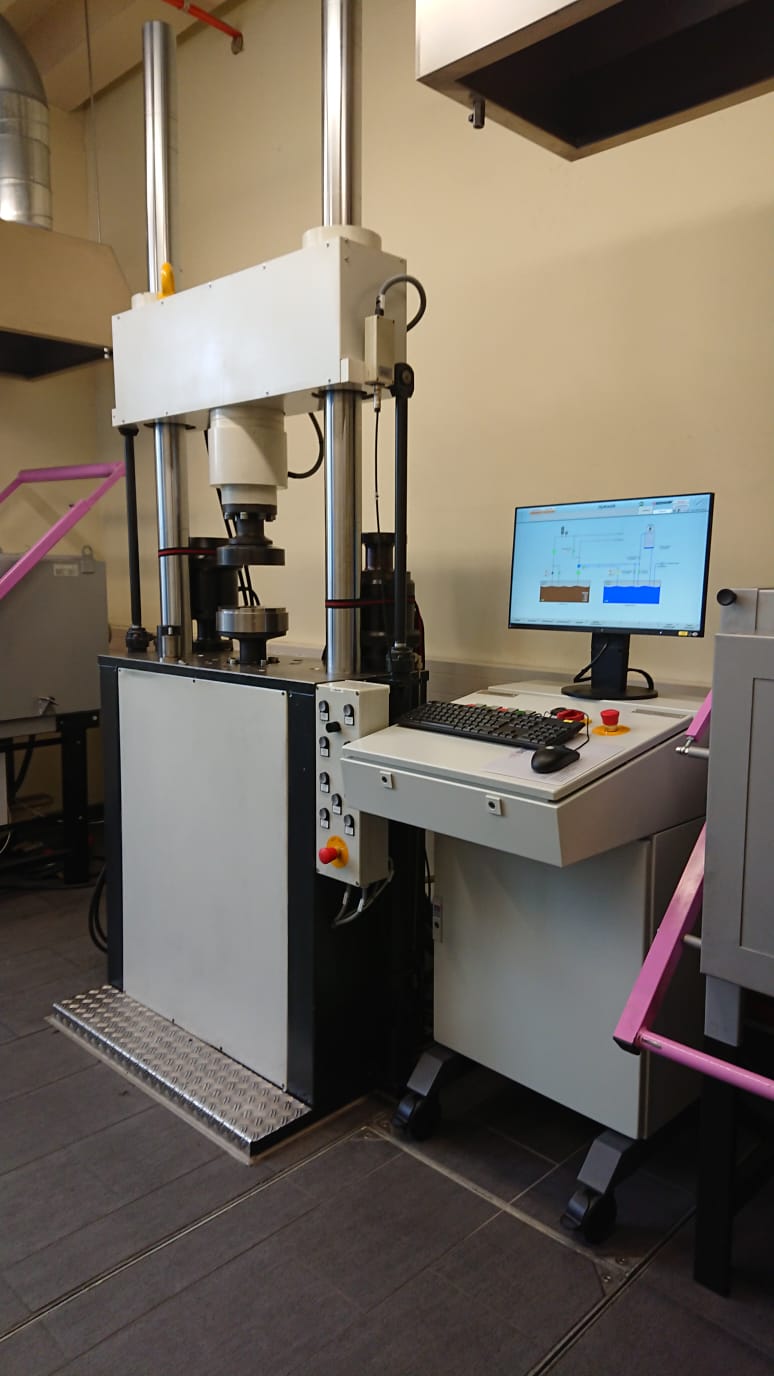
The institute has two universal testing machines AG 100 and AG 50 from Shimadzu for the destructive testing of materials using tensile tests, tear tests and compression tests. The larger AG 100 is equipped with a Vialux video extensiometer and hydraulic clamping jaws.
In addition to classic materials testing, the systems at the Institute of Metal Forming are also used for adhesive strength tests using shear tensile tests and Chalmers tests as part of work on material composites.
For hot tensile tests, the AG 100 can also be fitted with a multi-zone radiation furnace, which can heat and hold the samples at a defined temperature.
Sheet metal testing machine BUP 600
The BUP 600 sheet metal testing machine from Roell Amsler enables the Institute of Metal Forming to test sheet metal materials in complex deformation states or to carry out standardised and recognised sheet metal tests such as the bulge test, the cell drawing test, the hole expansion test or the recording of FLD curves.
The system is equipped with a camera system from Vialux, which allows visioplastic monitoring of the test and precise evaluation of the local changes in shape with the help of the scanned samples.
It can be operated at elevated temperatures up to 300°C and in various test types, either with a punch or hydrostatically.
Magnetic measuring station MPG 100D
The MPG 100D magnetic measuring station from Brockhaus has various measuring coils so that circular blanks can also be measured in addition to metal strips, which allows the magnetic properties to be determined depending on the direction of orientation.
The magnetic measuring station offers the option of direct current or alternating current measurement. The magnetic properties that can be determined using the magnetic measuring station include
- specific magnetic losses P [W/kg]
- Remanence Br [T]
- coercive field strength Hc [A/m]
- effective polarisation J [T]
- . polarisation J [T]
- magnetic field strength H [A/m]
- AC/DC permeability μ
- AC/DC hysteresis loops
- Remagnetisation curves
Technical data of the systems