Continuous rolling mill
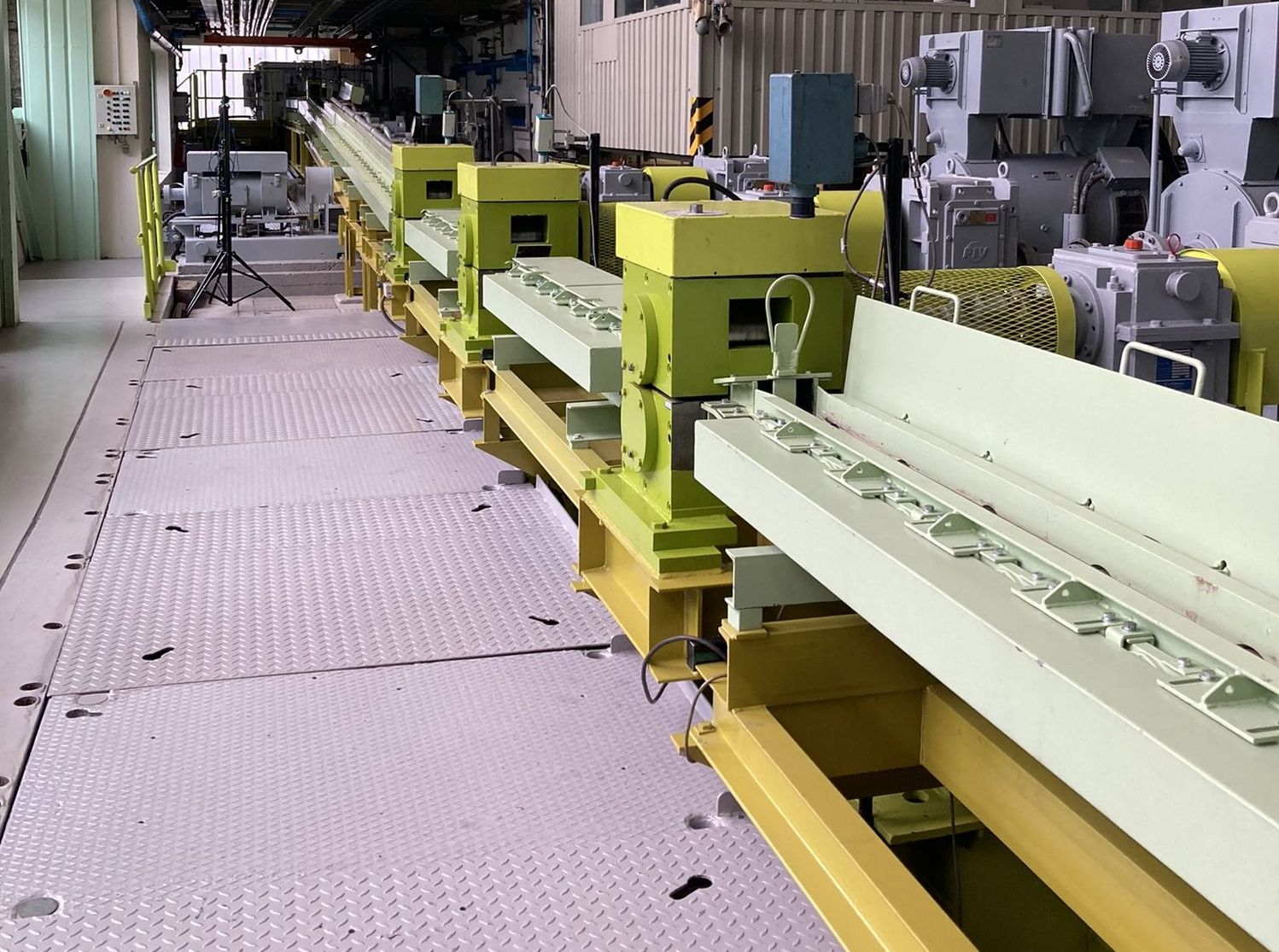
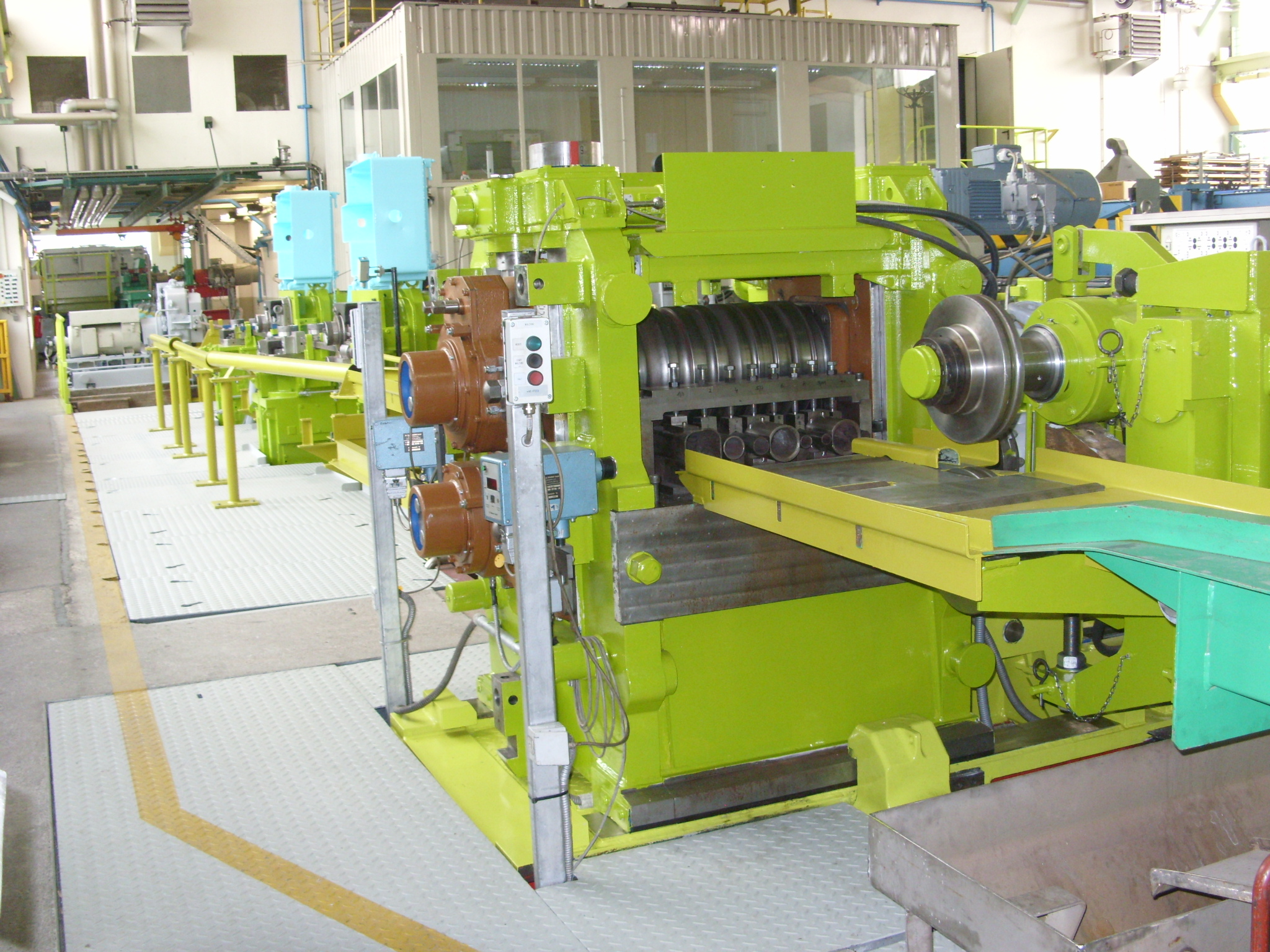
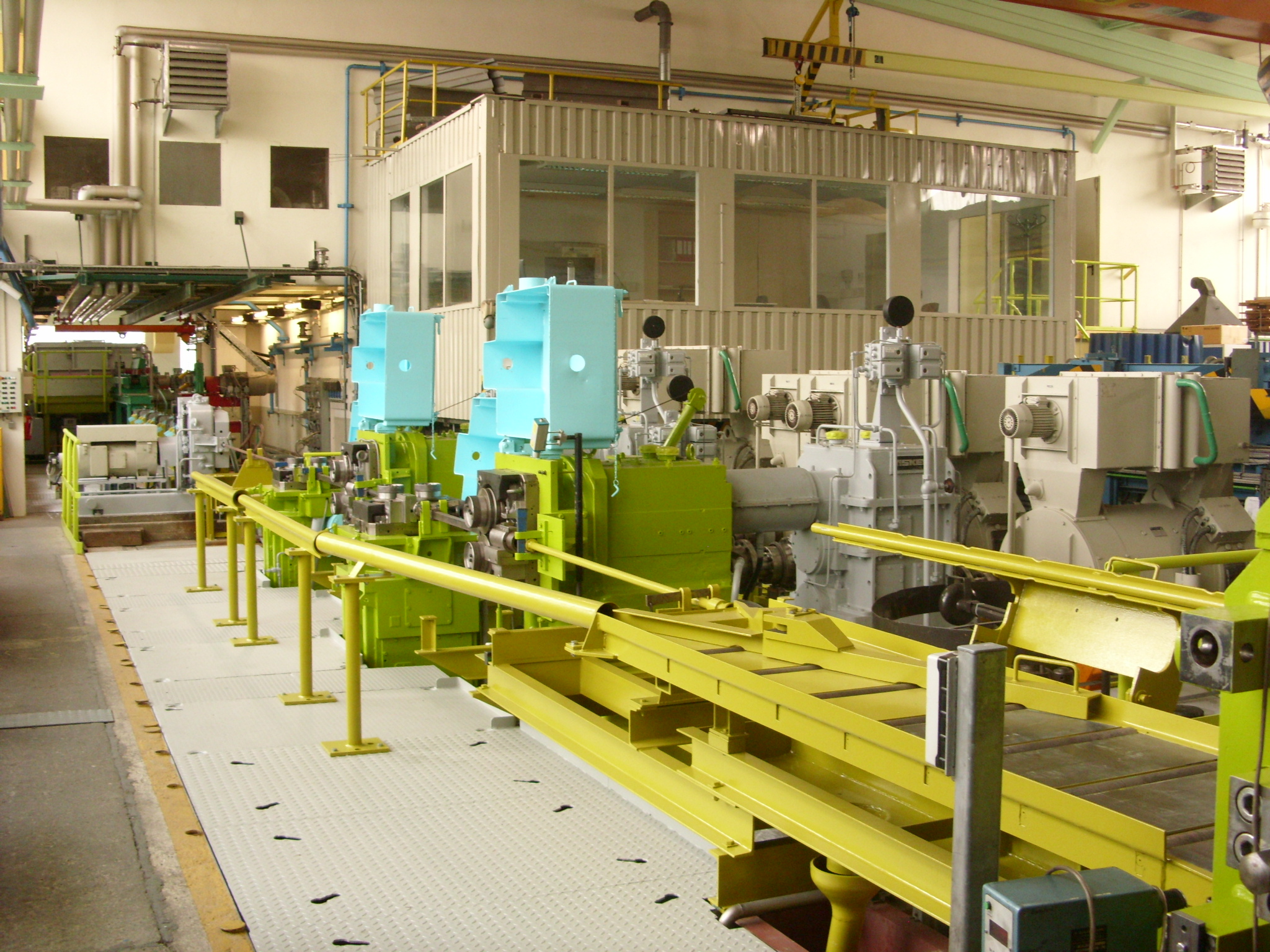
The centrepiece of the rolling mills at the Institute of Metal Forming is a multi-stand continuous rolling mill for simulating real hot rolling processes for flat or long products on a laboratory scale. Similar to the design of the SACK test rolling mill, great importance was also attached to the design and realisation of the continuous rolling mill in order to achieve the most universal structure possible and the possibility of realising a wide range of tasks. The plant can be operated in both wire and flat configurations and enables industry-oriented research into the rolling process with up to four (flat) or five (wire) individual stands in a continuous arrangement.
As a result, the plant, which was commissioned in 1980 and last modernised in the early 2000s, is now an integral part of the Institute and an important basic building block for modern, practical training and research at the Institute of Metal Forming and enables diverse and sometimes unique implementation options within complex task areas and research topics.
Flat configuration
In the flat configuration, the continuous rolling mill consists of a two-high reversing stand, which serves as a roughing stand, and a continuous finishing train with three two-high rolling stands in a housingless design. Upstream of the reversing stand is an optional scale washer for removing the primary scale and a driver for feeding the sample into the reversing stand and the subsequent housing stands for finishing rolling after pre-rolling.
The starting material can be heated either inductively or in preheating furnaces, optionally also in a combination of inductive rapid heating and equalisation time in the preheated furnace. The final finishing stand is followed by the cooling section, in which cooling can take place with defined parameters. Finally, the finished strip can be moved into a rack furnace, which can realise defined cooling curves in different temperature zones - for example to simulate coil cooling.
The speeds, rolling forces and torques of all stands are recorded using data technology and it is possible to measure and record the temperature at different points in the rolling mill using pyrometers. Accordingly, the continuous rolling mill can be used to simulate various hot rolling processes based on real hot strip mills or to research new technological possibilities.
Wire configuration
In the wire configuration, calibrated rolls are used in the Duo roughing stand, which allow reversing pre-rolling of the rolling block up to the entry diameter of the finishing mill. The subsequent finishing train consists of four rolling ring stands in an H-V-H-V arrangement, whereby the stands and the rolling rings used correspond to the actual systems in industrial finishing rolling blocks.
The heating can be carried out either inductively or in heating furnaces, optionally also in a combination of inductive rapid heating with subsequent equalisation in the furnace. A driving stand is located in front of the reversing stand for the required rapid driving of the rolling bar into the finishing train. After the finishing train, the rolled stock passes through a water cooling section for defined cooling.
The degree of the rolling train is formed by a coil layer for the finished wire. The coils are deposited from the rotary tube onto a link conveyor belt and can continue to cool either slowly in still air or accelerated by blast air supplied from below (Stelmor cooling). If the finished wires are short enough, they can also be fed into the rack furnace for flat strip in order to simulate defined cooling/holding curves.
The speeds and rolling forces and torques of the roughing stand and the finishing train can be recorded electronically, and the temperature can easily be measured at desired points along the rolling line using pyrometers. In this system configuration, the processes in real wire rod and bar steel mills can be simulated and new technologies for new materials can be developed realistically on a small scale.
SACK reversing frame
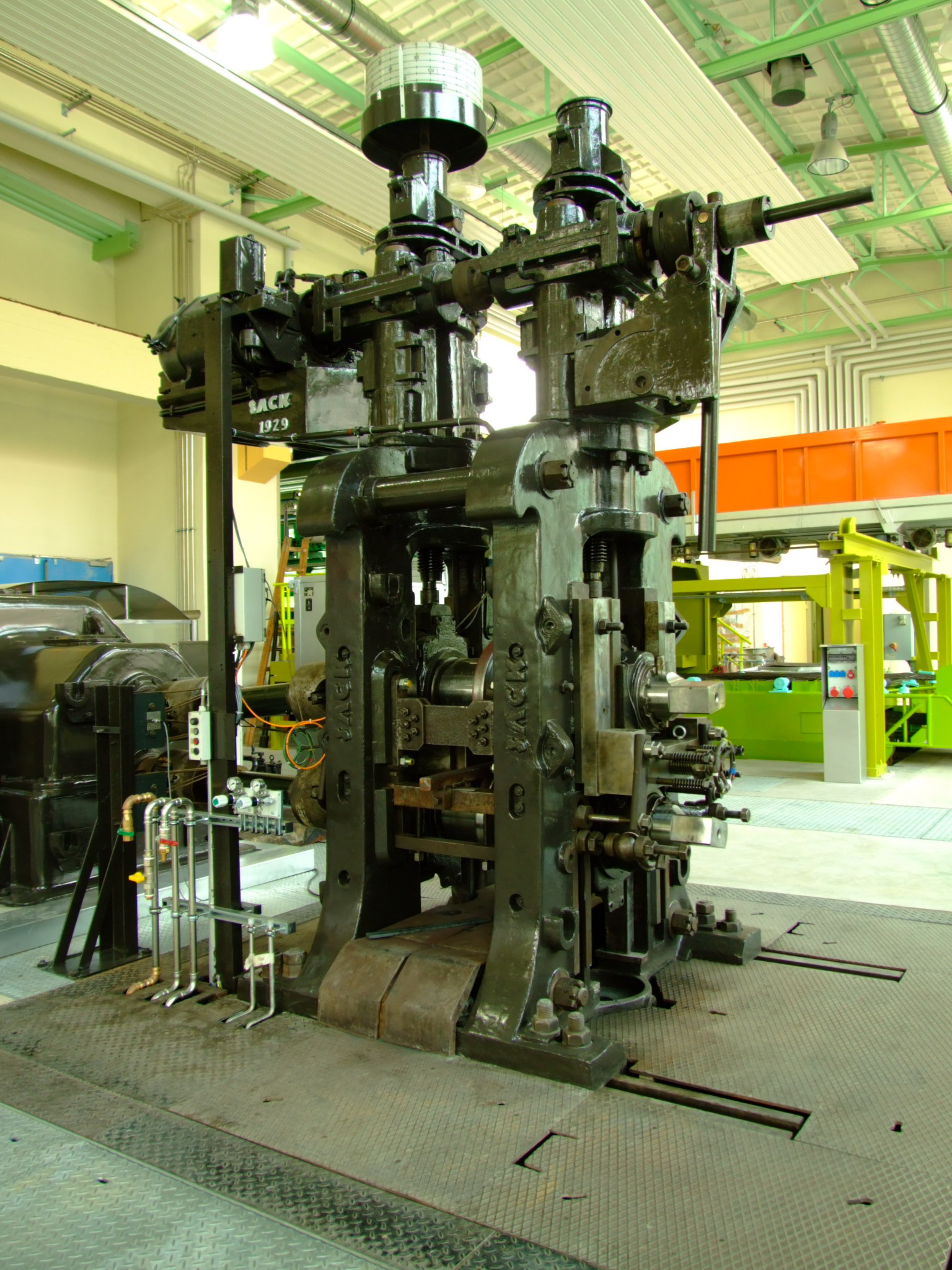
With the appointment of Dr Otto Emicke to the Chair of Rolling Mill Technology and Transport Engineering at the Bergakademie in 1928, the history of rolling mills at today's Institute of Metal Forming also began. The duo reversing stand from the SACK company was designed as a pure test rolling mill according to Prof. Emicke's plans during the construction phase and officially put into operation in January 1930.
In a revised and modernised form, the rolling mill is still used today for extensive and demanding research work in the field of rolling flat and long products at the Institute of Metal Forming. The foresight of the original design with a movable roll stand, which allows the use of different rolls with bale lengths of 500 to 800 mm as flat or calibre rolls, has repeatedly proven to be advantageous for the implementation of many research projects.
In addition to the duo configuration, the stand design also enables the realisation of multi-roll installations (quarto and universal installation). Additional equipment can also be installed before or after the stand, such as descaling test systems or cooling sections. For the evaluation of rolling tests, the stand is equipped with devices for measuring speed, rolling force and rolling torque as well as piercing and final rolling temperatures using pyrometers. Due to the extensive research activities in the field of the lightweight material magnesium, the stand was also equipped with a roll heater, which allows the work rolls to be preheated to up to 130°C in the Duo installation.
Cold rolling mill
For investigations into the rolling of thin sheet and cold strip and for research into new technology concepts for cold rolling, the Institute of Metal Forming has a cold rolling reversing stand, which can be operated in duo and for particularly thin dimensions or solid materials in quarto installation.
The stand has two coils, so that strips can also be rolled in reversing mode in addition to sheets. The stand is equipped with load cells for measuring the rolling force and the option of recording the rolling speed and roller speed.
Trio street
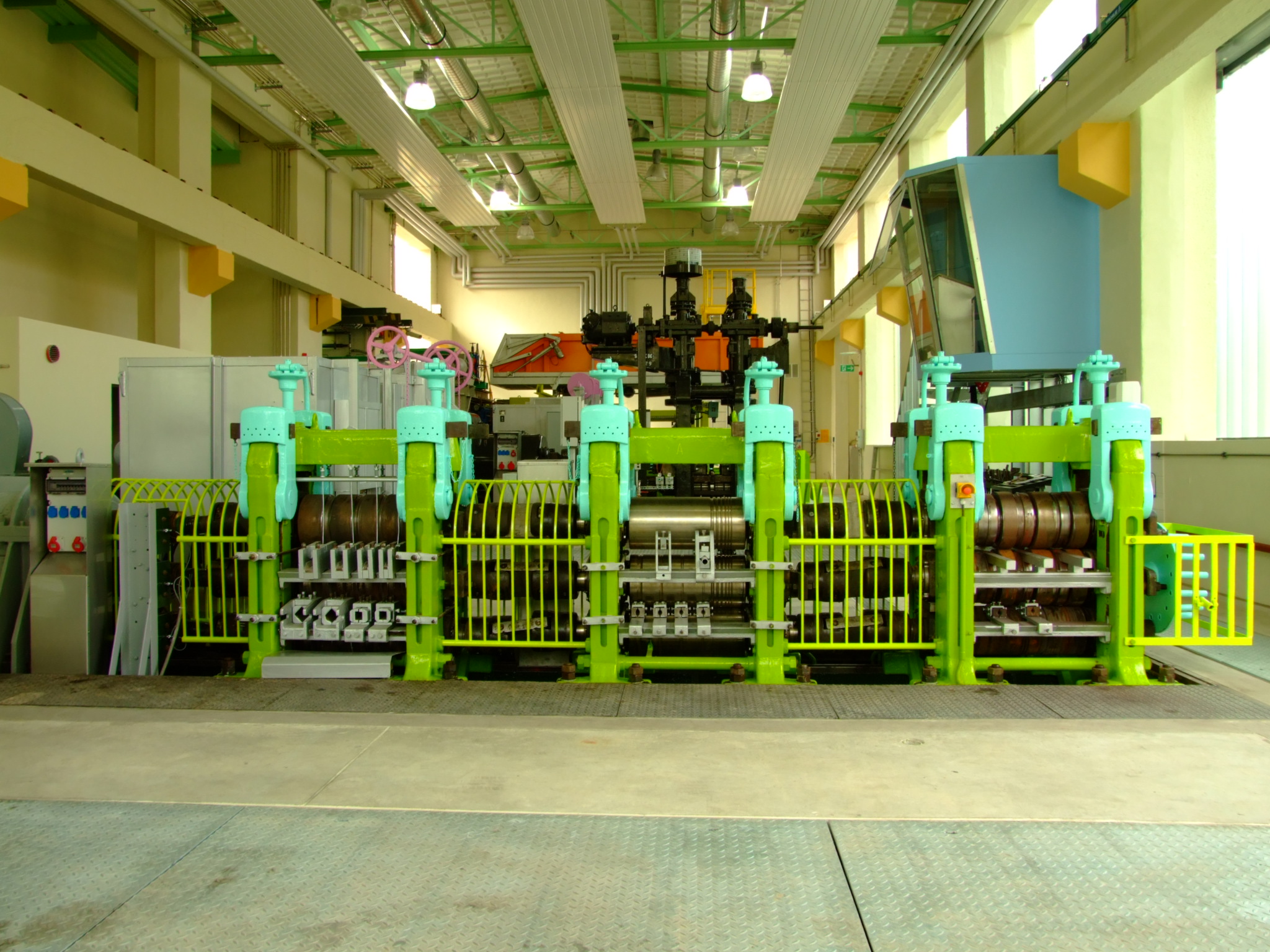
For research activities and technology development in the field of long products, the Institute of Metal Forming has an open, three-stand fine steel rolling mill with trio rolling stands. The existing calibre rows enable the rolling of round and square cross-sections in various final dimensions.
In addition to the production of primary materials for further tests, e.g. wire drawing, the trio mill is also often used for research in the field of non-ferrous metals and special materials. To measure the process-relevant data sets, the trio mill is equipped with torque measurement on the drive spindles and load cells for measuring the rolling force on all three stands. Several pyrometers can be connected to different measuring points for temperature measurement.
Technical data of the systems