The Numerical Simulation Research Group focuses on the provision and further development of numerical and associated experimental methods for describing material behaviour before, during and after forming, as well as the forming processes themselves.
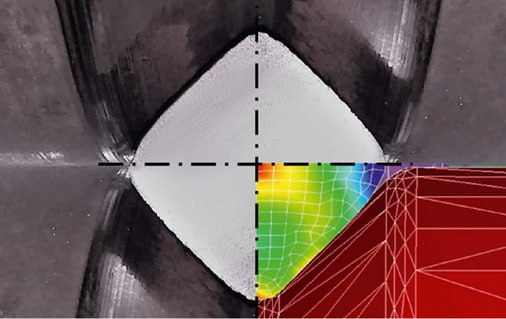
In addition to carrying out process simulations and modelling forming processes, the Numerical Simulation Working Group’s remit also includes the development and provision of its own models and software solutions for investigating problems in forming technology, tailored to the concrete, specific characteristics of the processes. Particular emphasis is placed on reducing computational effort by avoiding time-consuming numerical methods, such as the FEM. This enables the use of rapid feedback loops, which, for example, allows for iterative design, numerical optimisation or statistical process analysis within a more practical timeframe.
This development work involves combining and integrating existing models and sub-models into commercial or in-house simulation tools, developing new modelling techniques, and optimising existing models for modified problem formulations. In addition, the work of the Numerical Analysis Group also involves the development and integration of algorithms and methods for the analysis of experimental data and experiments. The tools and software solutions provided are intended to enable staff and students at the institute, as well as clients and collaboration partners, to tackle the given problems independently.
Team and Contact

The working group deals with the following topics
The working group’s research focuses on describing the material-physical processes occurring within the material before, during and after a forming process.
At the heart of these methodological developments is the open-source software PyRolL, developed by the working group. Existing knowledge in the field of rolling calibration is made available for research, teaching and production in the form of software packages – most of which are freely available – under the BSD-3 licence.
The knowledge and methodology of rolling calibration, together with the computational principles of rolling processes for bar and wire as well as symmetrical and asymmetrical forming dies, are taught not only in academic courses but also in publicly accessible training programmes organised by the International Calibration Centre.
Based on the IMF’s extensive experimental datasets, fundamental research is being conducted into the application of artificial neural networks and deep learning methods in metal forming.
Support for projects can be provided in the following ways
- Simulation-based analysis of material flow during casting, billet rolling, heavy plate rolling and strip rolling, as well as in bulk forming processes
- Methodological and modelling support for mapping the relationships between alloying elements, forming conditions, microstructural development and precipitation behaviour, as well as their relationship to product properties
- Simulation-based analysis of opportunities for shortening process chains and optimising processes, taking into account material and process-related influencing factors and energy requirements
- Simulation and optimisation of flat rolling under homogeneous and inhomogeneous material conditions, including the use of a layer model (LaySiMS)
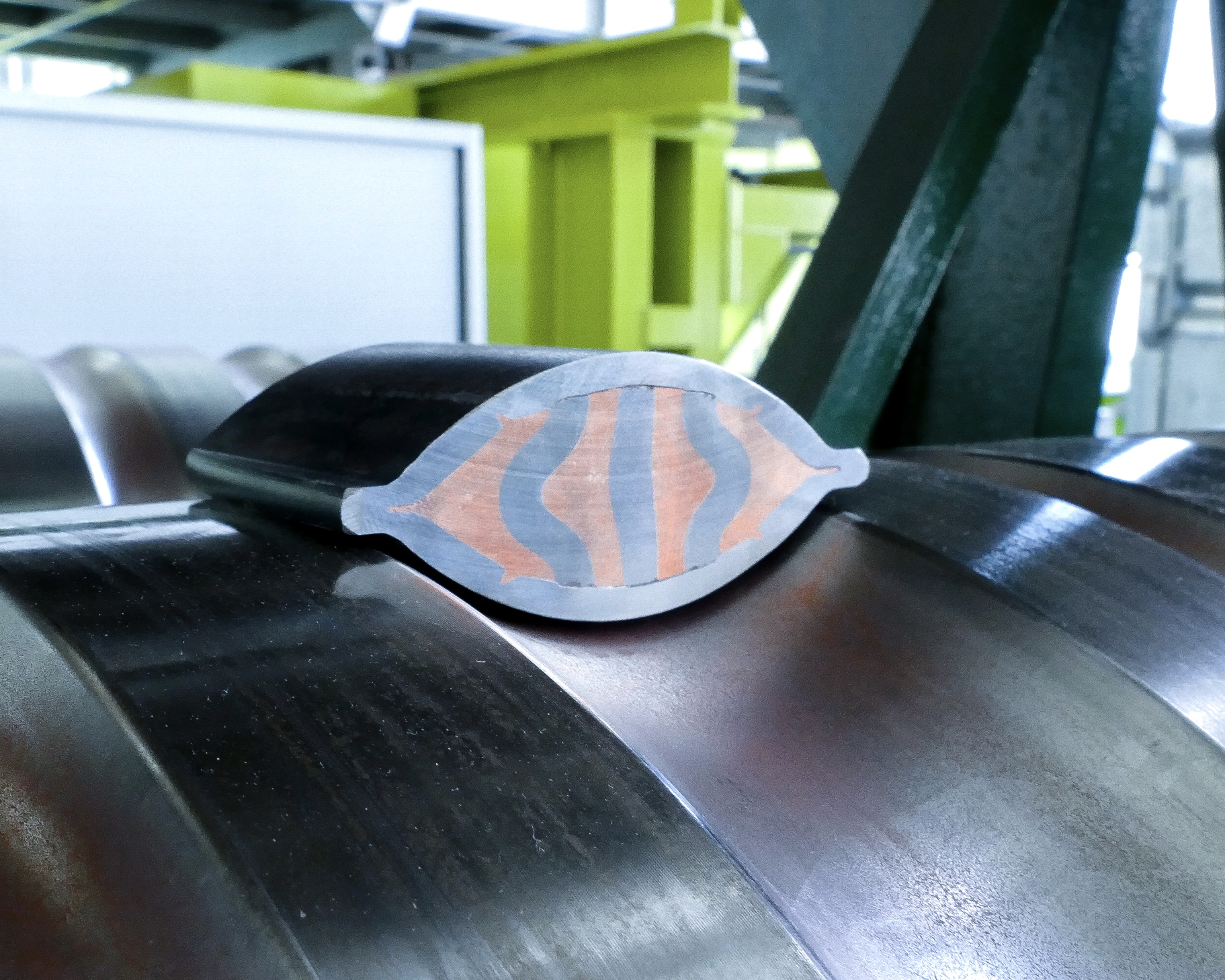
- Development and refinement of composite materials for flat products
- Design of calibres, pass sequence planning, microstructural development, and optimisation of force and energy requirements during rolling in drawing and forming calibre series for the production of wire, bar steel and sections;
- Simulation of material flow as a function of material type and condition, geometric conditions in the forming zone, and tribological and process-related conditions for long products;
- Support with the numerical analysis of thermomechanical stresses on rolls, in particular rolling discs, for wear minimisation
- Design-related safety assessment of the calibre arrangement, taking into account local roll stresses using PyRolL
- Support in the development of in-house process software based on the PyRolL system
- Training of staff in the field of rolling technology and rolling simulation within the framework of the International Calibration Centre
- Simulation of sintering processes with non--ideal particle geometries
- (simulation-based tool design)
Collaboration takes place with the Light Metals and Steel Materials and Heavy Metals working groups for the experimental validation and ongoing expansion of the models.