Advanced Materials Analysis
The targeted development of new materials (materials design) and the manufacture of components with the desired properties require a combination of academically driven and application-oriented research that focuses on describing functional relationships. Consequently, there is a constant demand in both academia and industry for scientists with in-depth knowledge of instrumental solid-state analysis and semiconductor technology.
The Master’s programme in Advanced Materials Analysis is aimed at graduates of Bachelor’s programmes in physics, materials science, electrical engineering or chemistry who wish to deepen their knowledge of the use of instrumental materials analysis methods, physical measurement methods and/or semiconductor technology.
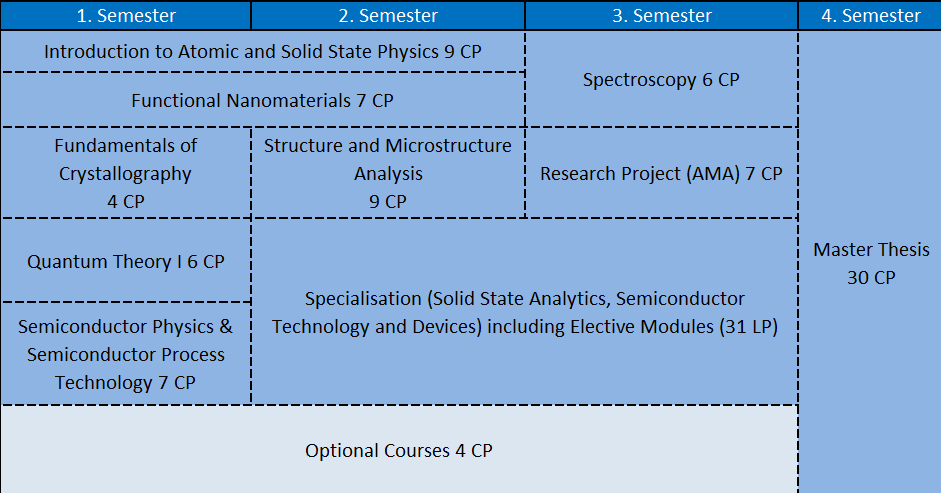
From the second semester onwards, students can choose one of two specialisations:
Solid State Analytics
The ‘Solid State Analytics’ specialisation focuses on the structural and microstructural analysis of primarily inorganic materials (semiconductors, ceramics, metals and their alloys) for electronics, sensor technology, optical applications and energy systems. The most important analytical methods include electron microscopy, spectroscopic methods and diffraction methods. A unique feature of the programme is the provision of modules on synchrotron sources and free-electron lasers, and their use in in situ analyses of rapid processes in modern materials.
Semiconductor Technology and Devices
The specialisation ‘Semiconductor Technology and Devices’ focuses, on the one hand, on imparting knowledge of semiconductor process technology – that is, how semiconductors are processed to manufacture devices from them. On the other hand, it covers the physical functioning of various devices from the fields of electronics, optoelectronics and photovoltaics in theory, simulation and practice. Furthermore, the course introduces electrical, optical and structural measurement methods that can be used to investigate structure-property relationships, for example in relation to atomic point defects and their influence on device behaviour.
Good to know
Please note that this is an English-taught Master’s programme. Applications are made online via the university portal and can be submitted between 1 January and 15 April.
- Materials Analysis
- Quality Control
- Semiconductor Industry
- Ceramics industry
- Composite materials manufacturers
- Metallurgy
- Research institutions
- Faculty
-
Faculty of Materials Science and Technology (Faculty 5)
- Degree
-
Master of Science (M.Sc.)
- Standard period of study
-
4 Semester
- Part-time possible
-
No
- Start of studies
-
Winter semester
- Admission requirement
-
- A Bachelor’s degree (minimum 6 semesters) or an equivalent degree in materials science, physics, chemistry, electrical engineering or engineering sciences with a focus on materials science, which should cover topics in the field of solid-state physics or solid-state chemistry.
- Assessment of qualifications (including an online test in mathematics and physics)
Please note: Applicants with a Degree in ‘Mechanical Engineering’ who did not specialise in any of the areas listed above during their studies cannot be admitted for academic reasons.
Language skills- English language skills: TOEFL with a minimum score of 4.5/90 (internet-based test) or
- IELTS with a minimum score of 6.5
Native English speakers are considered to have equivalent proficiency.
- Course language
-
English
Requirements
Entry requirements
Bachelor’s Degree
Admission to the Master’s programme in Advanced Materials Analysis is restricted to those who have completed a first professional Degree lasting at least six semesters at a university
- in a degree programme with a focus on materials science
- in a degree programme with a focus on engineering, with evidence of knowledge of materials science, or
- in a degree programme in physics or chemistry
Please note: Applicants with a Degree in ‘Mechanical Engineering’ who did not specialise in any of the areas listed above during their studies cannot be admitted for academic reasons.
Language skills
Proof of English language proficiency via a recognised language test, such as the Test of English as a Foreign Language (TOEFL) with a score of at least 90 (internet-based test) or the International English Language Test System (IELTS) with a score of at least 6.5, or an equivalent test with a corresponding result, is also an admission requirement. English as a first language is recognised as equivalent.
Personal qualities and interests
Curiosity and an interest in the natural sciences
Reasons to choose the Master’s programme in Advanced Materials Analysis
TUBAF is a small university with close links between the natural sciences and engineering disciplines, and a strong focus on materials science.
Students study in small groups and receive direct support from their lecturers.&
Students can choose between fundamental or practice-oriented topics and gain further experience through TUBAF’s collaboration with Saxon research institutes and industry.
Contact for further technical enquiries
Should you have any further academic enquiries, please do not hesitate to contact either Dr Dirk Renker or the Dean of Studies, Prof. David Rafaja:
Frequently Asked Questions (FAQ)
What Numerus Clausus (NC) do I need to study at TUBAF?
All Bachelor’s and Diplom degree programmes at TUBAF are open to all applicants, i.e. there is no minimum entry requirement. The only deciding factor is your university entrance qualification (e.g. Abitur). The Master’s programmes also have no admission restrictions – however, it is advisable to check the specific entry requirements for each programme. These can be found in the ‘Requirements’ section and in the programme documents.
How long does the Advanced Materials Analysis degree programme last, and when does it start?
The standard duration of study is 4 semesters. A total of 120 credit points must be obtained.
The programme begins in the winter semester.
Who should I contact if I’m coming from abroad?
If you have any questions about your studies – such as the application process or enrolment – the International Office is here to help. For first-year students moving to Freiberg from abroad, TUBAF offers a Buddy Programme.
For programme-specific enquiries, please contact the Central Student Advisory Service and the academic advisory service of the relevant faculty (see the information box at the top of the webpage).
Where can I find information about funding my studies and accommodation?
Information on funding your studies is summarised on the ‘Funding your studies’ webpage.
We have compiled information on accommodation here.&