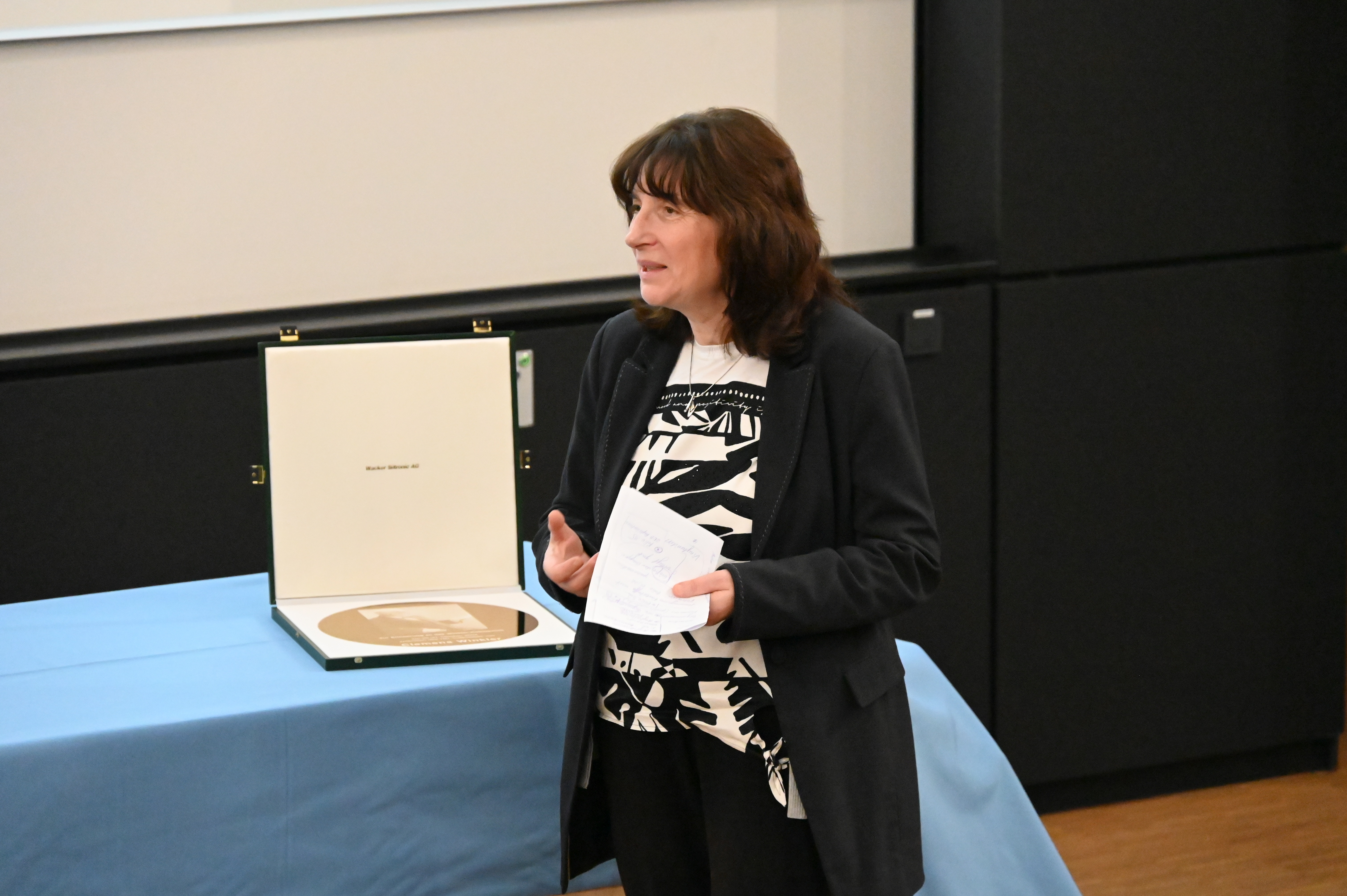
Clemens-Winkler-Kolloquium 2026
am 21.10.2026, 16:15 Uhr zum Thema: "100 Jahre Schrödinger-Gleichung" im Hörsaal A der Universitätsbibliothek
Prof. Matthias Scheffler
The NOMAD Laboratory at BIFOLD,
Technische Universität Berlin, Franklinstraße 28-29, D‑10587 Berlin, Germany
Beyond the Schrödinger Equation: Density-Functional Theory, Interpretable AI, and the Intricacy of Real Materials
A century after Schrödinger and Heisenberg formulated quantum mechanics, their two mathematically equivalent formulations remain the foundation of our understanding of matter. Yet, as Dirac famously noted in 1929, the resulting equations are far too complicated to be solved exactly. Kohn’s density-functional theory transformed this situation by enabling practical approximations for the exchange-correlation energy, making the many-electron problem tractable and laying the foundation for modern computational materials science.
Yet the behavior of real materials is governed by an intricate interplay of mechanisms and processes that extends beyond explicit electronic-structure calculations and statistical mechanics. In this talk, I will discuss how interpretable artificial intelligence, in particular symbolic regression using the SISSO approach, complements electronic-structure theory by identifying the key physical descriptors governing materials properties, quantifying the trustworthiness of predictive models, and guiding the discovery of promising materials in vast, largely unexplored chemical and structural spaces.
Prof. Thomas Heine
TU Dresden, Theoretische Chemie
Quantum Materials: Still Surfing Schrödinger's Wave
I will present some of our latest work on quantum materials. Latest advances in precision synthesis has allowed us to design materials with topologically intriguing structures bottom-up. This is particularly interesting for low-dimensional materials, such as planar carbon lattices in one and two dimensions, and for reticular materials such as covalent organic frameworks and metal-organic frameworks. In some of those materials, the lattice topology is transferred into topologically nontrivial electronic structures, such as topological insulators, highly correlated electronic structures with Dirac points and flat bands, metal-free magnets, and altermagnets.
Schrödinger’s wave has been surfed for a century by quantum chemists, who elevated chemistry from an empirical science to a rational discipline of science. Now, 100 years after its postulation, it has become a tsunami, bravely surfed by the pioneers of quantum technology.
Flyer Clemens-Winkler-Kolloquium 2026
GDCh-Kolloquien im Wintersemester 2026/27
Alle Kolloquien finden - falls nicht anders angekündigt - 16:15 Uhr in der Lessingstraße 45 im Hörsaal LES-1001 statt.
28.10.2026
Prof. Jens Weber
Hochschule Zittau-Görlitz
"Dynamische Polymernetzwerke - von Grundlagen zu Anwendungen"
11.11.2026
Prof. Ralf Zimmermann
Uni Rostock
"Inestigation of Hazardous Dust particles to identify security-relevant content from shipments, baggage or other emittors"
25.11.2026
Three-Minute-Thesis
Wettbewerb, organisiert vom JungesChemieForum
13.01.2027
Prof. Torsten Gutmann
Uni Paderborn
"Hyperpolarization and In-situ NMR – Powerful Tools to Study Local Structures and Processes in Functional Materials and Catalysts"
27.01.2027
Prof. Silvia Vignolini
MPl for Colloids and Interfaces, Potsdam
"Bio-inspired self-assembled chiral architecture for optics and plasmonics"

Clemens-Winkler-Kolloquium
13.11.2025
Rückblick